
The decision between operating with an in-house IT team or relying on managed IT services has become a priority for companies looking to grow without driving up costs or overwhelming their technical staff.
Both models deliver value in different ways. In-house IT offers closer business alignment and more direct control, while managed services provide specialized expertise, ongoing support, and more predictable costs.
The goal is not to choose a universally “right” model, but the one that drives greater efficiency, lower risk, and better ROI based on the company’s growth stage.
Why Companies Choose an In-House IT Team
An in-house IT team is made up of professionals hired directly by the organization to manage networks, technical support, infrastructure, backups, and other critical functions.
Its main advantages include:
- More control over priorities and technology decisions
- Better understanding of the business
- Closer collaboration with internal teams
- Faster response to daily operational needs
This model also comes with significant challenges:
- Higher fixed costs
- Limited after-hours support without 24/7 coverage
- Skill gaps in specialized areas like cybersecurity, cloud, or SD-WAN
- Staff turnover that can affect continuity
According to the 2024 IBM report, more than half of organizations affected by a breach faced a shortage of cybersecurity staff, increasing the pressure on internal teams when stronger response capabilities are needed.
Why Companies Choose Managed IT Services
Managed IT services involve partially or fully delegating technology functions to a specialized provider that is responsible for operating, monitoring, optimizing, and supporting key components of the IT environment.
This model allows companies to access technical expertise, proactive monitoring, and continuous coverage without needing to increase their internal headcount.
Main advantages of managed IT services:
- Predictable costs and better OPEX control
- Access to specialized talent without increasing headcount
- Proactive monitoring to reduce incidents and downtime
- Scalability and 24/7 support for critical environments
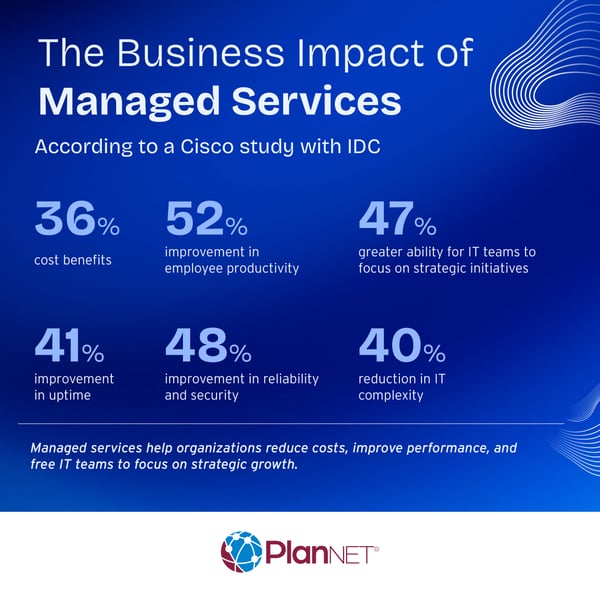
According to a Cisco study conducted with IDC organizations using managed services report cost savings, higher productivity, better uptime, stronger security, and less IT complexity:
Like any outsourced model, this approach also requires evaluating certain factors to ensure efficient operations:
- Dependence on the provider for critical functions
- Less direct control over some operational processes
- Risk of misalignment if there are no clear SLAs, well-defined governance, and consistent communication
Key Differences Between In-House IT and Managed IT Services
| Aspect | In-House IT | Managed IT Services |
| Operational control | High | Shared |
| Costs | Higher and more fixed | More predictable, adjustable, and scalable |
| Specialization | Limited to hired talent | Access to multidisciplinary experts |
| 24/7 coverage | More difficult to maintain | Easier to enable |
| Scalability | Slower | More flexible |
| New project implementation | Depends on internal capacity | More agile with specialized support |
Managed services have evolved beyond traditional support. Today, they span multiple layers of technology operations, including managed network services—one of the most critical functions for scaling and addressing specific business needs.
Managed Network Services as a Driver of Growth and Scalability
Cisco and IDC found that managed services help free up IT team capacity. In fact, 46.9% of organizations said their teams could focus more on strategic initiatives, while 41.1% reported improved uptime and 47.6% saw better reliability and security.
As companies grow, their needs for connectivity, security, visibility, and support also increase. Managed services help them scale faster without expanding internal teams at the same pace, improving cost control and speeding up the deployment of new capabilities.
Learn more about IT Enterprise Network Support and how it can improve your business operations while helping you reduce costs.
Choosing the right IT partner is as important as choosing the right technology.
At PlanNet, a Cisco Partner, we help companies improve efficiency with managed IT services for enterprise networks, backed by our expertise and the Cisco ecosystem.
Our services help organizations reduce costs, access specialized talent, improve business continuity, ease the burden on internal teams, scale securely, and benefit from 24/7 support and monitoring:
- Optimize operating costs
- Access specialized talent without increasing headcount
- Improve operational continuity
- Reduce the burden on internal teams
- Scale in a structured and secure way
- Benefit from 24/7 advisory and continuous monitoring
While internal IT teams provide close alignment with the business, managed services add specialized expertise, continuous monitoring, greater scalability, and better cost control.
Contact us for IT consulting and let us help you achieve cost-effective enterprise network management.

You may also be interested in reading more about what Is a network assessment and why is it important for your business?